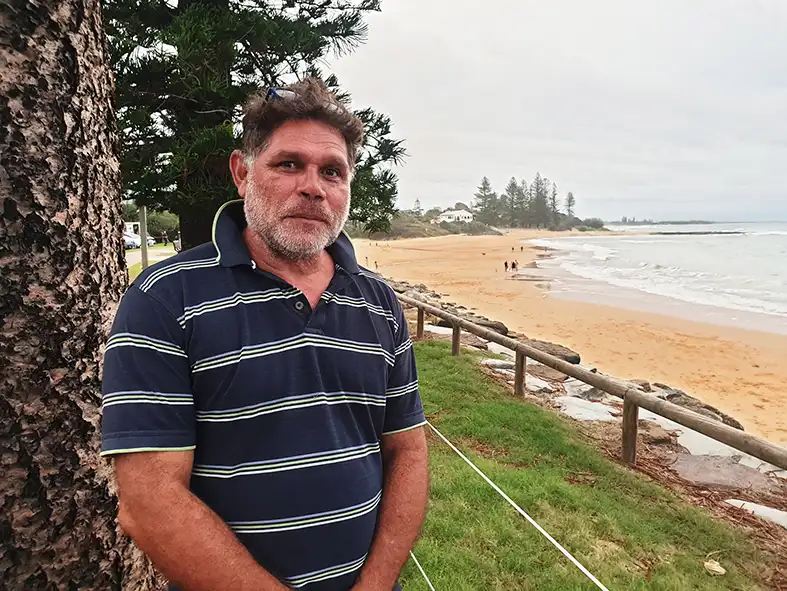
Kabi Kabi man Brian Warner emphasises the importance of unity, calling on the community to come together in pursuit of lasting environmental solutions.
I am a Kabi Kabi man. I have other nations in my blood, but first, I identify this way. My mother and grandmother are Kabi Kabi, so here I am.
I lived most of my life at Moffat Beach, this beautiful part of the world—Tooway and Moffat Beach headland. I lived here a long time, and I miss it. I used to walk my blue staffy, stroll along Shelly Beach and through Watson Park. There’s still so much cultural significance here; you just have to open your eyes and know the place.
I grew up with the trees, with that deep cultural connection—to the pandanus trees, the coast banksias, pigface, the casuarina tree (the whistling tree), the sedge grass, and the sand creepers (goat’s foot). You start to feel the country. You realise the Norfolk pine doesn’t belong here. This would have been like rainforest before it was cleared for a town. I think about how beautiful it must have been, how many native species of flora and fauna were here. A lot of the animals you see up in Cairns probably once lived down here. The cassowary was as far south as the Tweed River.
Aboriginal people have been here for thousands of years, living in and around these waterways. Our culture extends from the sea all the way to the mountains. We are connected to this place, we have learned how to survive—through everything, even the ice age.
People say it’s nature, what is happening to Bribie Island with the breakthrough—that the island has always restored itself—but I don’t think we’re going to see it this time. I’ve seen this happen before. I’ve seen it shift, rebuild somewhere else, because that’s what water and nature do. The old people used to talk about it, how the island would move but always return. I just watched another breakthrough, and this time, I’m watching it not come back. I’ve seen the sand moving; it’s at the mouth near the Bulcock Beach end, covered in. But shouldn’t there be the same size opening, the same distance as the mouth elsewhere?
Before, people weren’t affected by disease because the water was flushing itself out. Now there’s E. coli in the water. Something isn’t right. Something needs to be done. I’ve been coming to Golden Beach for five years, watching the changes, seeing the widening of the break. Even our oral history tells us—it’s not coming back. Something feels lost.
I’ve never seen the beach look like this at Moffat Beach. Somehow, it’s all connected. The ocean sand here is trying to tell us something, I feel it is ill and needs some kind of remedy.
We should listen to the surfers. They know how the ocean and the sand have changed. It’s time to come together, all communities—to protect our one community.
We need one voice. We can’t afford to have all these different groups pulling in different directions. There is no point in the Kabi Kabi coming in until everyone else sorts themselves out first.
We are tired of having the same conversation over and over again. We need people to work together so we can help provide solutions. Nobody wants to point fingers. We just want to do something—find a solution and fix it.