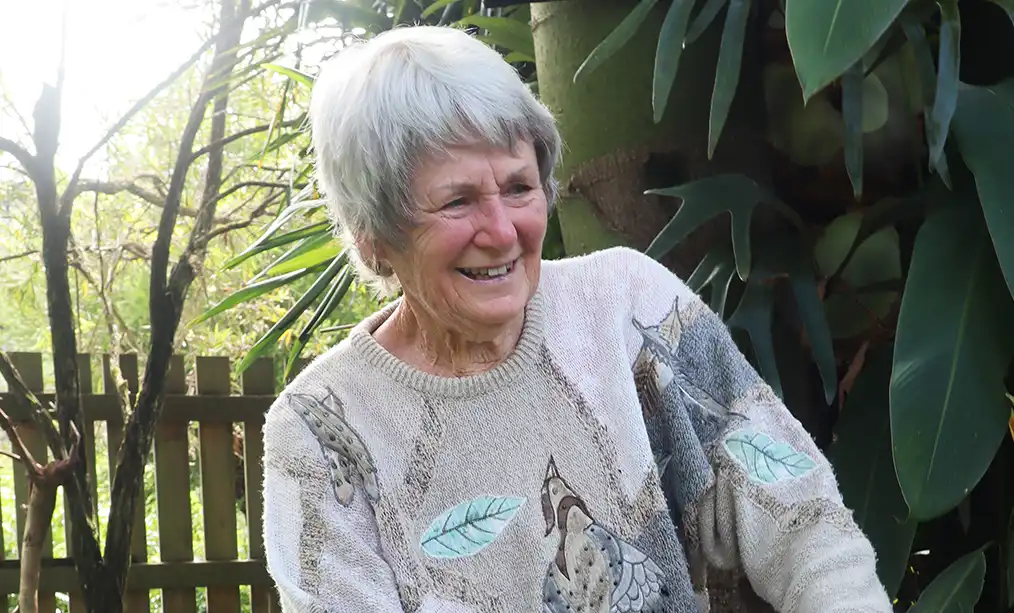
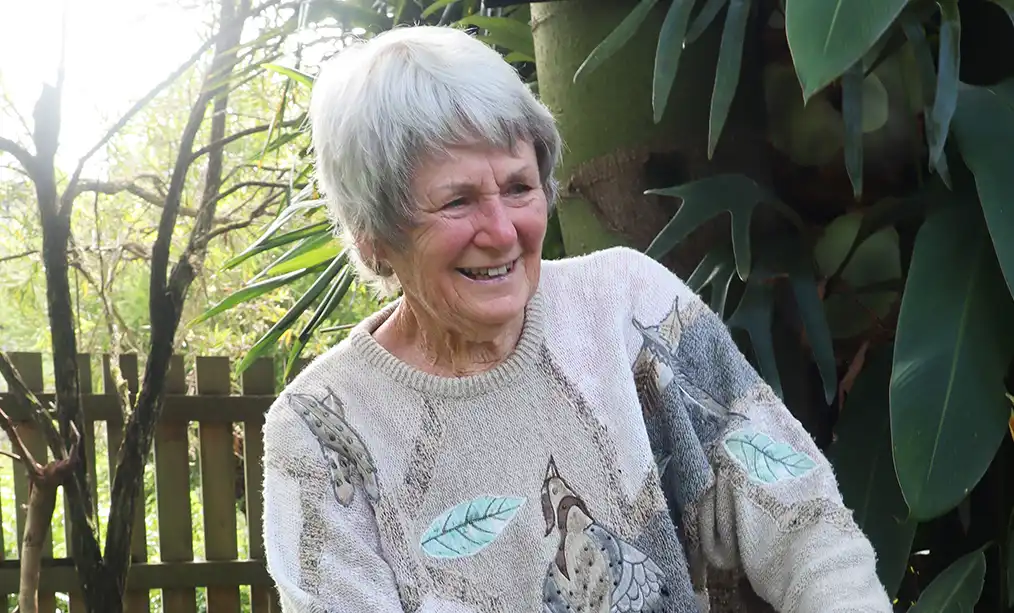
A passionate teacher can leave an indelible mark on a community—and few embody that truth more fully than Anne Wensley. Environmentalist, educator, activist, and historian, Anne has been a cornerstone of Caloundra’s story for over six decades. Since arriving with her husband in 1965, this long-time local has woven her life, heart, and work into the very fabric of our coastal town.
Caloundra has grown dramatically over the last 60 years—and so has Anne, who has been there every step of the way. A passionate “greenie” long before the word was popular, Anne credits her late mother with sowing the green seeds in her head and heart. “Mum had a bush garden in the 1950s and was deeply moved by Rachel Carson’s book Silent Spring when it came out. That was the beginning of the environmental movement.”
Anne is a life member of the Wildlife Preservation Society, an organisation she joined in its early days under the leadership of renowned conservationist Kathleen McArthur. “I’ve followed its evolution ever since,” she said.
Today, she continues to nurture those values through writing Caloundra’s history for this very magazine and advocating for local sustainability. Her legacy runs deep—in the schools, the streets, and even in the trees.
Anne and her husband Selwyn arrived in Caloundra in the early 1960s when he was transferred to the town’s secondary department as a math and science teacher. “There were only about 80 students at the time,” Anne recalls. As was typical then, she had been dismissed from her own teaching position simply because she was married.
The couple rented her grandmother’s old holiday cottage, at 4 Rinaldi Street in Moffat Beach, complete with a wood stove and thunderbox toilet. “We were entranced by the area,” she said. “Within six months, we knew we were staying.”
Anne’s bond with the town is deeply personal. She was conceived in her grandmother’s Moffat Beach house, which still stands today. At age eight, after undergoing heart surgery, she returned to Caloundra to recover. Her two daughters, Carmen and Yvette, were raised and schooled in Caloundra, and when Selwyn passed away in 1997, his ashes were scattered at Military Jetty. “Caloundra is very special to me,” she said.
Anne returned to teaching in 1965, going on to work at Caloundra Primary, Maleny High, Caloundra High and Maroochydore High before retiring in 1998. “That’s a hell of a lot of people I taught,” she laughed. Many still greet her with warmth and recognition around town. Her unwavering dedication to students was honoured in 1995 when she was named a state finalist in the Excellence in Teaching Awards—nominated by the students and parents themselves. “Teaching is one of the most important careers—you have the power to change the direction of a child’s life,” she reflected, offering heartfelt encouragement to today’s teachers who may be feeling overwhelmed in the current climate.
Anne was instrumental in pioneering relationship education in Queensland schools. As a leading teacher in the Personal Development Program, she taught values, communication, sexuality and self-esteem.
But her influence reached far beyond the classroom. In 1967, Anne and Selwyn helped found the Sir Francis Nicklin Memorial Salt Water Pool Committee. “He was teaching kids to swim in the Passage,” she said. “Then he got a letter from the department saying if anyone drowned, he’d be up on manslaughter charges.” That letter sparked a campaign that eventually led to the pool’s opening in 1977.
Anne’s first public protest came in 1989 when she famously refused a wheelie bin. “I don’t believe in waste. Waste is a misplaced resource,” she insisted. When the council kept delivering the bin, she kept returning it—until the standoff hit the front page of the Sunshine Coast Daily. That led to the formation of Caloundra Kawana Wastebusters and a community-run recycling depot at Warana. Her activism almost landed her a council seat—missing out by just 76 votes—but she was appointed to the Waste Advisory Committee and helped design the Corbould Park Resource Recovery Centre, an achievement she remains deeply proud of.
Anne’s environmental activism often came with a touch of humour. When council plans in the 1970s threatened the gum trees outside her Carlton Avenue home, she wrote a letter “from the trees” on their own leaves, pleading for their lives. It worked. Shire engineer Max Poole, whose children Anne had taught, took notice, engaging newly appointed town planner, Peter Allen, to design the road to curve around the trees. “There’s a lot to be said for lateral thinking and humour,” she said. Eric Williamson, a bush poet on the work crew, even penned a poem about the experience called The Day the Road Went Round the Ironbarks.
Now enjoying retirement in her self-designed recycled home, Anne tends her permaculture garden with help from the onsite WWOOFER (Willing Workers on Organic Farm), cares for her dog Lucy, enjoys her seven grandchildren, and continues her community work through writing. “When we came here, I was 22 and Caloundra had 2,000 people. We really did grow up together, and we’ve both come a long way.”